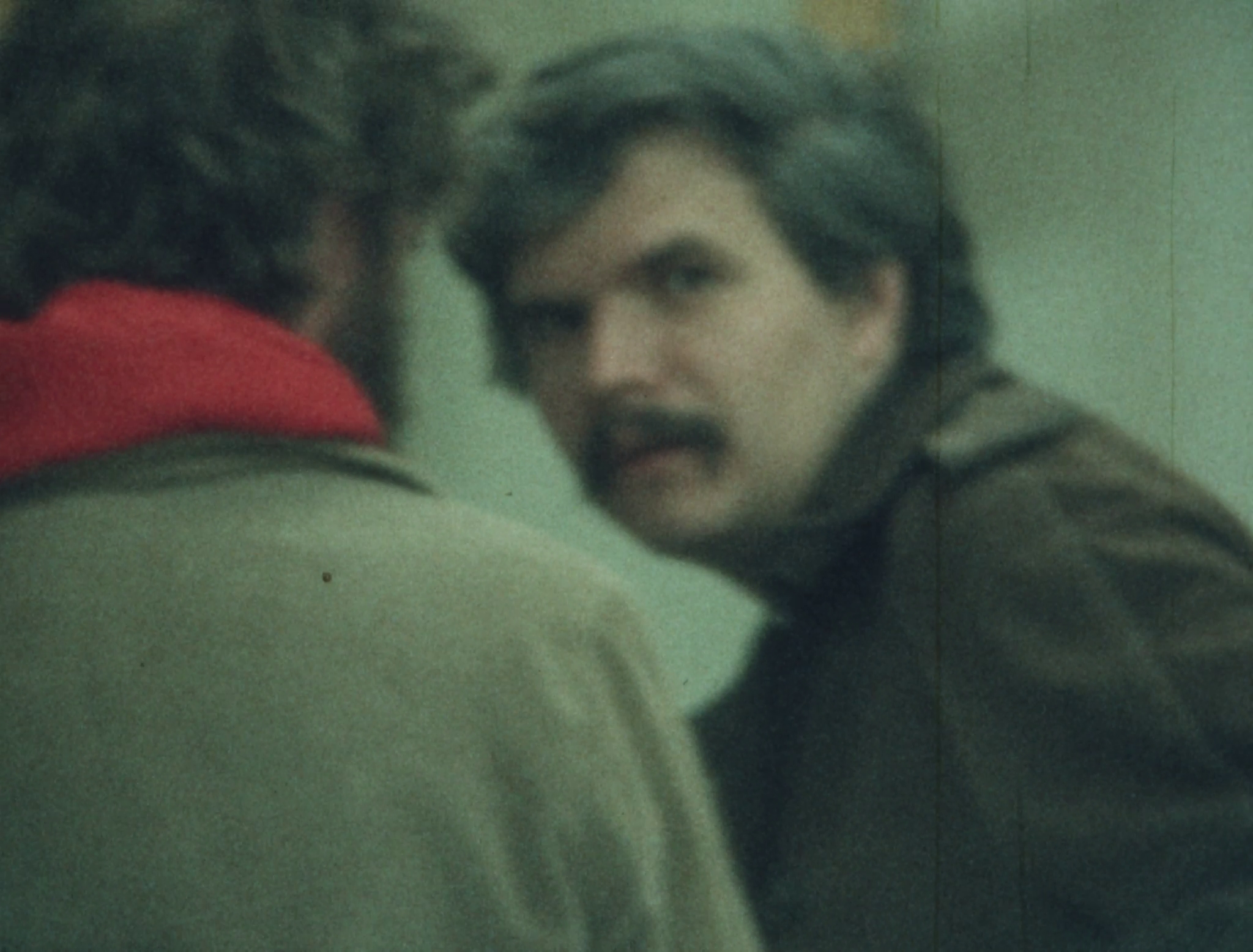
As a precocious teenager with a troubled family life and a voracious appetite for monster movies, Pittsburgher Greg Gans set out to express himself in the mid-1960s with small gauge film, starting with his atmospheric and surprisingly gory 8mm “Dracula,” produced over the course of two and a half years. By the end of the 60s, Gans turned his attention inward with “Dirwood Kirby on Uranus,” an experimental film made by a teen with no access to the underground. This would become the first work ever presented at Pittsburgh Filmmakers in 1971, a critical resource to Gans’ development as an artist in the coming decade.
In this time, he completed at least 15 films, including, among others, the perspective bending textural study “Pastel Film,” the achingly intimate interpersonal poems that comprise “The Family Films” series (once described by anthropologist Richard Chalfen as “anti-home movies”), and even a portrait of Stan Brakhage during one of his visits to Pittsburgh (a film which Brakhage liked so much that he traded Gans one of his own films in exchange for a print.) Between 1978 and 1984, Gans worked on his most ambitious project yet, “The Coming of the Kingdom,” a workprinted-but-not-quite-completed 16mm spiritual meditation on humanity that would fit right in with a Terrence Malick epic.
Then Gans moved to Philadelphia, where he studied visual anthropology and ethnographic film and worked professionally in film and video, with jobs in government, local cable, theater, and more. His Pittsburgh film work has gone almost entirely unseen for the past 40 years, in which time tall tales took hold about the fate of Gans and his films. At last, we are honored to have helped restore from Super 8 originals many of his finest films. A poet of film reappears.
Doors at 7:30. Show at 8:00.
At the Glitterbox Theater
———————
ABOUT ESSENTIAL PITTSBURGH
Pittsburgh Sound + Image seeks to redefine our region’s film history with the Essential Pittsburgh series. We acknowledge the depth of creativity which has flourished here by spotlighting vital artists and their films from the 1960s through the 2000s. This landmark series is a continuation of our efforts to celebrate a fuller picture of independent, amateur, industrial, and experimental filmmaking talent, and to better situate Pittsburgh nationally as a place of rich cinematic history.